Justice Tarot Card Meaning
Justice represents fairness, truth revealed, accountability. Numbered 11 in the Major Arcana, it signals fairness when upright and warns of bias or unfairness, denial of responsibility, self-judgment in reverse. In yes-or-no readings, Justice is a maybe.
Justice, Card #11 of the Major Arcana, is the moment the lights come up and everything on stage is suddenly visible. This card speaks to truth, cause-and-effect, and the quiet power of owning your choices. It asks: if your life were on record, would you feel at peace watching it back?
In a reading, Justice invites you to consider where balance, honesty, and integrity are needed right now. It highlights contracts, agreements, boundaries, and the stories you tell yourself to justify your actions. Rather than punishing, this card is about clarity: seeing what is actually happening, acknowledging your part in it, and choosing the most fair, aligned path forward—for you and for others.
Modern framing & layout: Flickerdeck (2025).
Key Themes
Upright
Reversed
Artwork & Symbolism
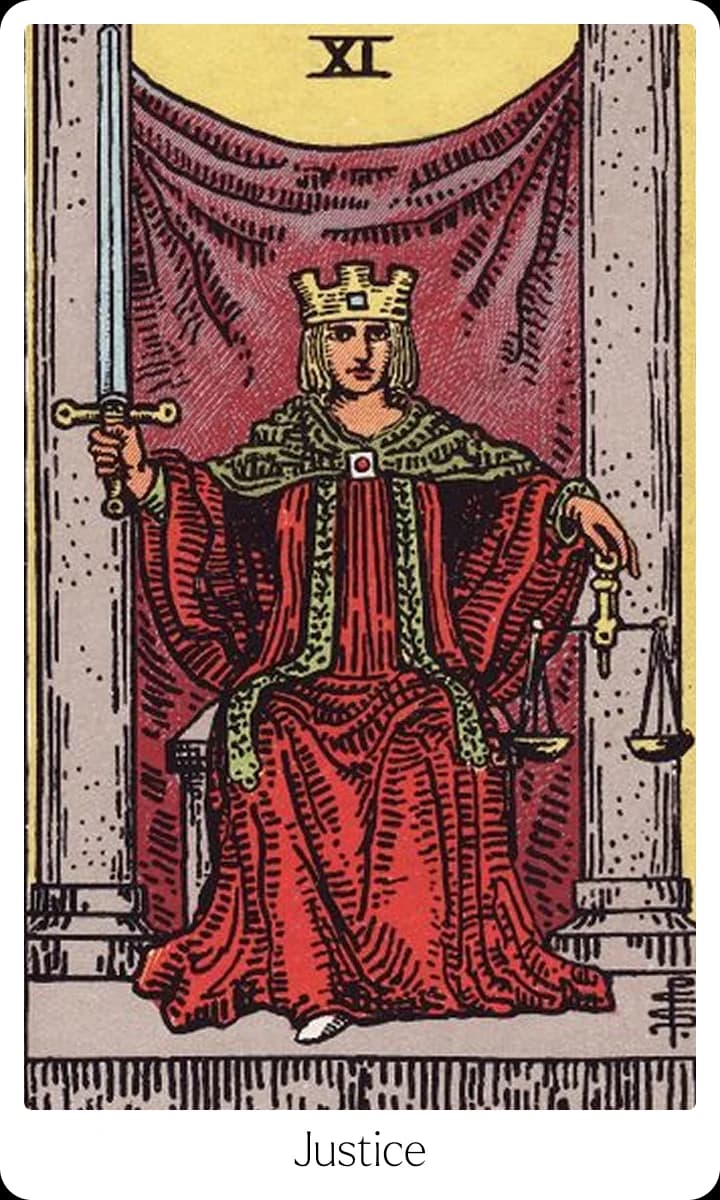
You’re looking straight at a crowned judge on a stone throne, and that front-facing stillness is the point—Justice doesn’t let you hide from what’s true. The deep red robe and curtain bring a sense of seriousness and consequence, while the grey pillars and marble seat feel like rules that don’t bend for anyone. Above her, XI stamps the moment as a formal reckoning: this is the part where things get named.
In her right hand, the sword rises perfectly vertical—clear decisions, clean cuts, no fuzzy excuses. In her left, the golden scales hang level with empty pans, reminding you that fairness starts with an honest weighing of facts, not a pre-written verdict. The green patterned sash crossing her chest reads like ethics worn openly—integrity as something you carry, not something you claim.
Justice Upright
Upright, Justice points to a situation where fairness and truth matter more than speed or convenience. It encourages you to slow down, look at the facts, and make decisions you can stand behind later. This might involve legal paperwork, a tough conversation, or finally admitting what you’ve known deep down for a while.
This card supports you in acting with integrity, even if it costs you comfort in the short term. Justice suggests that alignment between your values and your behavior is the real win here. When you’re honest—with yourself and others—you stop leaking energy into defensiveness and can move forward with a clearer conscience.
Justice Reversed
Reversed, Justice shines a light on imbalance: something feels unfair, off, or skewed, but no one wants to name it. This can show up as blame-shifting, hidden information, double standards, or you being harsher on yourself than you’d ever be on anyone else.
This card invites you to examine where the scales are tipped. Are you avoiding responsibility, or taking on responsibility that isn’t actually yours? Reversed Justice doesn’t mean you’re doomed to an unfair outcome; it nudges you to seek more information, challenge bias—yours or others’—and advocate for a more honest, equitable arrangement.
Justice in Love
In love and relationships, Justice is the relationship check-in form you can’t ignore. It highlights reciprocity, respect, and whether both people are being emotionally honest. This card can point to serious conversations about commitment, boundaries, or what “fair” looks like in your dynamic.
Justice asks: are you both showing up with the same level of effort, truthfulness, and accountability? If conflict is present, it encourages listening to each side without scorekeeping, and making decisions based not on drama or guilt, but on what’s genuinely fair and sustainable for both hearts involved.
Justice in Career
In career and work, Justice focuses on contracts, policies, and the unwritten rules in your workplace. It can highlight performance reviews, negotiations, legal matters, or moments where you’re asked to stand up for what’s right—even if it’s not the easiest route politically.
This card invites you to align your professional choices with your ethics: fair pay, clear agreements, honest feedback, and transparent communication. If something feels unjust—credit not shared, expectations unclear, boundaries crossed—Justice encourages you to document, ask questions, and seek a solution that respects everyone’s rights, including your own.
Justice in Personal Growth
For personal growth, Justice is about radical self-honesty without self-cruelty. It asks you to look at your patterns and choices and say, “This is what I did. This is why. What do I want to do differently now?” It’s less about punishment and more about mature responsibility.
This card encourages you to balance compassion with accountability: not excusing harmful behavior, but also not defining yourself by your worst moments. Justice supports you in making amends where needed, setting clearer boundaries, and living in a way that matches the values you claim to hold.
Justice as Daily Guidance
Today, Justice invites you to pause before reacting and ask, “What’s the fairest, most honest way to handle this?” Read the fine print, listen to all sides, and choose the response you’ll feel proud of later, even if it’s the harder one in the moment.
Justice — Yes or No?
Is Justice a yes or no card? Justice is generally a maybe card. Justice is a conditional answer: yes, if things are handled fairly and honestly; no, if there’s secrecy, imbalance, or avoidance of responsibility. The outcome depends on how aligned your actions are with your values.
Justice as Feelings
As feelings, Justice is someone experiencing clear, measured emotion rather than being swept away. They may care deeply, but they’re stepping back to evaluate: Is this healthy? Is it mutual? They might feel the need to “weigh the evidence” before committing, wanting reassurance that they’re not being misled or compromising their values. There can also be a sense of moral concern—wanting to treat you fairly, or needing to see that they are being treated fairly in return.
Justice as a Person
As a person, Justice is the friend who reads the terms and conditions and actually understands them. They’re principled, sharp-minded, and often a bit intimidating because they see through excuses quickly. They value honesty, fairness, and clear agreements, and they’re not afraid to call out hypocrisy—sometimes bluntly. At their best, they’re a strong advocate and mediator; at their worst, they can become rigid, judgmental, or emotionally distant in their pursuit of being “right.”
How Different Artists Interpret Justice
Each tarot deck brings its own artistic voice and interpretive lens. Here's how 3 artists from Flickerdeck approach this card.

Pastel Dreams -Tarot
by Merve Yumak
Pastel Dreams frames Justice less as courtroom verdict and more as a soul-mirror—emphasizing embodied, compassionate accountability and the healing that comes when truth is felt rather than merely judged.
Unknown Shadows tarot
by Curator: Iurii Nazarenco
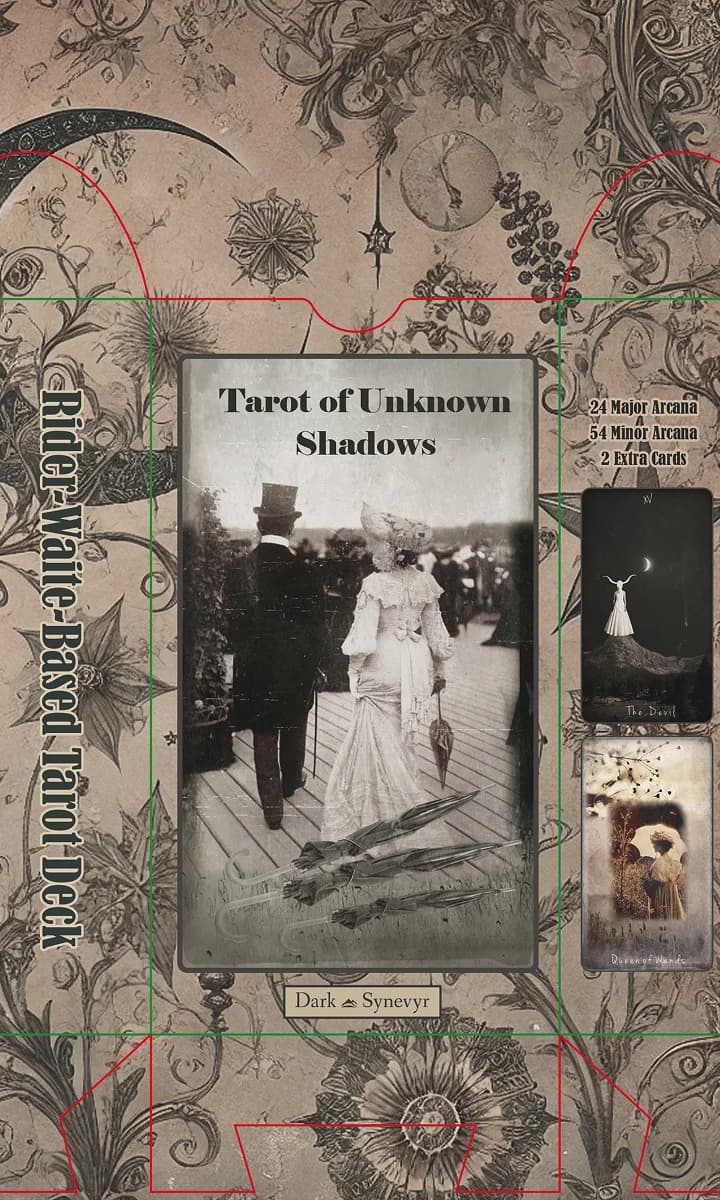
Rather than focusing on external judgment or legalism, this deck treats Justice as sacred witnessing—emphasizing inner accountability, reparative action, and the reconciliation of shadow and light.

City Goddesses Tarot
by Meiko Harris
This deck frames Justice as ancestral enforcement and active reclamation—less a neutral cosmic judge and more a summons to mobilize your heritage, accountability, and urban savvy to tip the scales back in your favor.
Justice in a Reading
In a reading, Justice highlights the parts of your spread that deal with choice, consequences, and ethics. Near past positions, it can point to a decision or agreement that’s still shaping what’s happening now. In present or challenge spots, it signals a need to confront the truth, seek more information, or address an imbalance you’ve been tolerating.
When paired with emotional cards like Cups, Justice suggests bringing logic and fairness into situations that feel messy or charged. With Swords, it emphasizes communication, legalities, and mental clarity. However it appears, this card asks you to consider not just what you want, but what is right—for you and for others involved.
Justice as a Birth Card
Justice appears in a birth card pairing when the usual birth-card date calculation reduces to 2 or 11.
Calculate your birth cards →Justice as your arcana
Your arcana is the single Major Arcana card from adding every digit of your birth date; Justice is arcana 11.
What it describes
Justice as your arcana means you carry a set of scales everywhere. You notice the split bill that wasn't split, the credit that went to the wrong person, the rule that applies to some people and not others, and it bothers you in a way you can't switch off. You think in cause and effect. Actions have consequences, yours included, and you'd rather own them than explain them away. Clear decisions come easier to you than to others because you've usually already done the weighing. Truth matters to you more than comfort. People who feel unseen elsewhere often feel seen by you, because you're paying attention to what's actually true.
Gifts and strengths
Integrity is your calling card, and it's not a performance: you hold yourself to the standard before you hold anyone else to it. You make decisions cleanly, laying out the facts, weighing them, and choosing, without the endless second-guessing that paralyzes other people. Boundaries come naturally to you, which means you can say no without drama and yes without resentment. You're the one people ask to referee, to review the contract, to tell them honestly whether they were in the wrong. Balance is a skill of yours too, in the sense of seeing both sides before you speak. And when you say something is true, people believe you, because they've never caught you bending it.
Challenges and shadow
The scales can tip into judgment. Fairness, held too tightly, becomes a running verdict on everyone around you, and people may feel assessed rather than accepted in your company. You can also be hard on yourself in a way you'd never be on others: a mistake from years ago still on the docket, a private courtroom that never adjourns. Bias is the shadow you're unlikely to see, because you're so sure you're being objective. And when a situation is genuinely unfair, you may take it on as a personal wound, exhausting yourself over wrongs that were never yours to fix. The work is to keep the clarity while letting mercy into the room, for others and especially for you.
In relationships
You are fair with the people you love, and they can feel it: chores split evenly, apologies made when they're owed, no favorites among the friends. Honesty is your love language, and you assume it's everyone's, which is where it can go wrong. A partner who wanted comfort may get a verdict; a friend who needed you to take their side may get both sides instead. Relationships are not court. Sometimes the fair thing and the loving thing differ, and the loving one is allowed to win. It also helps to let people be wrong occasionally without a hearing. You keep the scales balanced. Let someone else hold them now and then, and see how it feels to be simply forgiven.
In work and purpose
Law, policy, auditing, editing, arbitration, HR, journalism, science: any work where getting it right matters more than getting it fast suits you. You're valued in organizations as the person who notices what's off and says so, calmly, with the numbers. You make a good manager because people know where they stand with you, and a good negotiator because you actually want the deal to be fair. Truth and accountability are your ground: making sure the record is straight and the consequences land where they should. Rigidity creeps in when every gray area starts to look like a failure of nerve. Part of your job is to decide in them anyway, and to live with the weight.
Matrix of Destiny charts number these two the other way round — there, 8 is Justice and 11 is Strength.
Frequently Asked Questions
Is Justice a yes or no card?
What does Justice mean in love?
What does Justice mean for career?
What does Justice represent as feelings?
What does Justice reversed mean?
Experience Justice through Pastel Dreams -Tarot's unique voice in Flickerdeck
Discover tarot through dozens of artistic lenses — do readings, explore decks, and find the interpretation that resonates with you.
Get Flickerdeck